

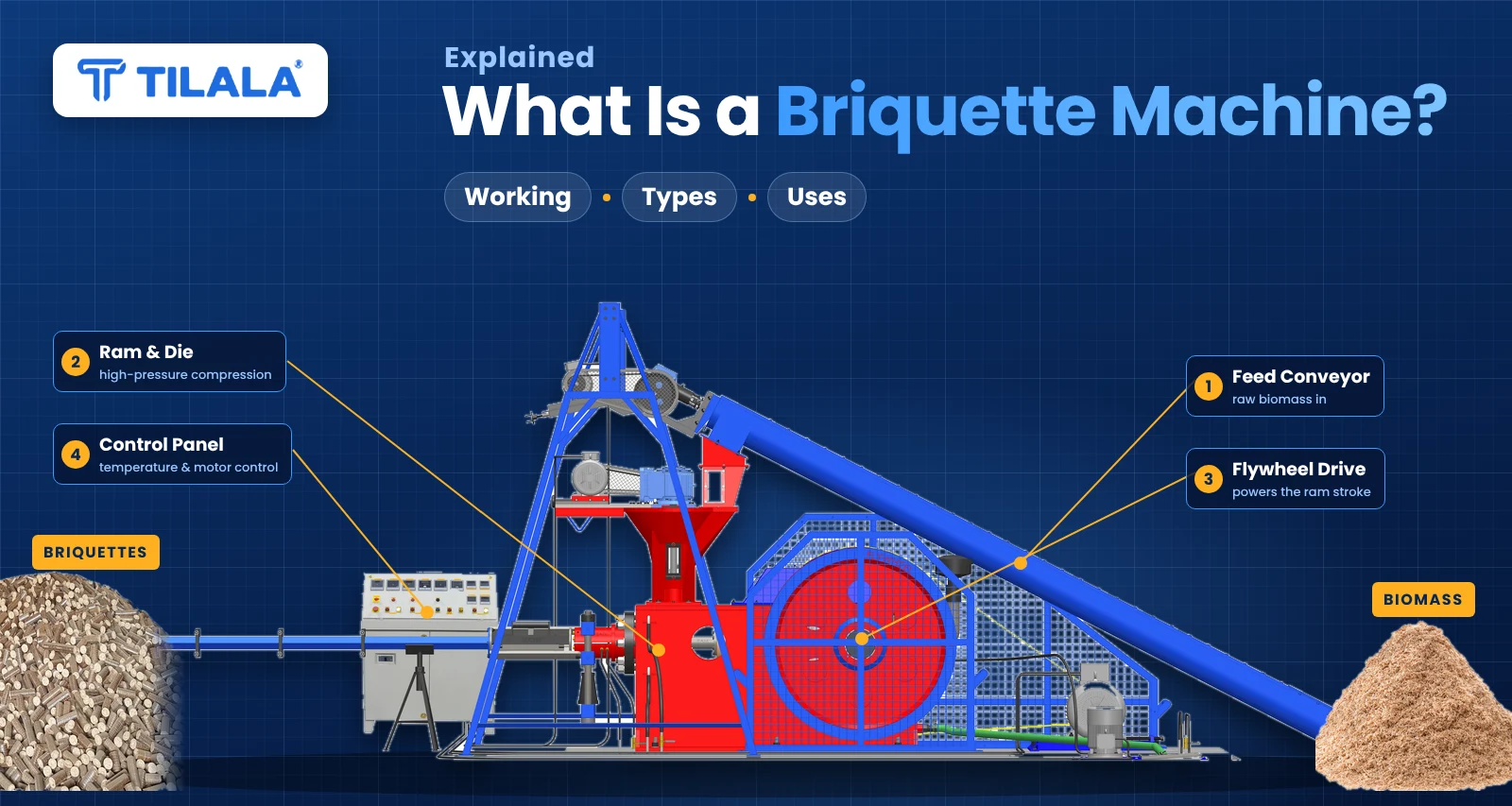
A briquette machine, also called a briquetting press or briquetting plant, is a machine that compresses loose waste material into dense, solid blocks called briquettes. In India it is mostly used to turn agricultural and wood waste such as sawdust, groundnut shells, cotton stalks and rice husk into a fuel that can replace coal and firewood in industrial boilers.
The machine applies very high pressure to the raw material. In most biomass briquette machines, no glue or chemical binder is added. The heat and pressure soften the lignin that is naturally present in plant material, and this lignin binds the particles together as the briquette cools.
What does a briquette machine do?
Loose biomass is bulky, light and difficult to burn evenly. A briquette machine solves that by making it:
- Denser: briquettes are several times denser than loose waste, so one truck carries far more fuel.
- Uniform: every briquette has a similar size, shape and moisture, which makes boiler feeding easier.
- Easier to store: compact logs take less space and create less dust than loose husk or sawdust.
- Better fuel: biomass briquettes typically give about 3,500 to 4,500 kcal per kg, depending on the raw material.
How a briquette machine works, step by step
A complete briquetting plant has a few machines working in a line. The briquette press is the heart of it.
- Collecting raw material. Agro or wood waste is collected and stored under cover.
- Size reduction. Larger material such as cotton stalk or wood chips goes through a crusher or hammer mill. Most machines need particles below about 25 mm.
- Drying. If moisture is above about 12%, the material passes through a dryer. Dry material such as sawdust or groundnut shell can often skip this step.
- Feeding. A conveyor or screw feeder carries the material into the press at a steady rate.
- Compression. A ram, piston or screw forces the material through a tapered die under very high pressure. Friction and pressure raise the temperature, which releases lignin.
- Forming and cutting. The compressed material comes out as a continuous log, usually 40 mm to 100 mm in diameter, and is cut to the length the buyer wants.
- Cooling and storage. Briquettes are cooled, then stacked or bagged for dispatch.
Each stage has its own machine. Tilala makes the hammer mill machine for size reduction, the dryer system for moisture control and the briquetting machine for pressing. For wood logs or veneer waste, a wood chipper machine comes first.
Types of briquette machines
| Type | How it compresses | Typical output | Best for |
|---|---|---|---|
| Mechanical piston (ram) press | A flywheel drives a ram that punches material through a die | 500 to 2,500 kg/hr | High-volume biomass plants, most common in India |
| Screw press (extruder) | A rotating screw pushes material through a heated die | 100 to 500 kg/hr | Smaller units, hollow briquettes, charcoal briquettes |
| Hydraulic press | Hydraulic cylinders press material into a mould | 50 to 1,000 kg/hr | Metal chips, low-volume biomass, quieter operation |
| Roller (ball) press | Two rollers with cavities press material into shapes | Varies widely | Coal fines, charcoal powder, mineral powders |
For biomass fuel in India, the mechanical piston type is the most widely used because it handles large volumes and long running hours. Machines are usually named by the diameter of the briquette they make, for example 60 mm, 70 mm or 90 mm models. Larger diameter usually means higher output.
Tilala’s 90 mm briquetting press is built for high-volume biomass plants and can produce up to about 2 tonnes of briquettes per hour, depending on the raw material.
Main parts of a briquette machine
- Feeder: controls how much material enters the press.
- Ram or screw: the part that applies pressure.
- Die and die holder: shapes the briquette. This is the main wear part.
- Flywheel and crankshaft: store and transfer energy in mechanical presses.
- Motor and gearbox: usually 40 HP to 100 HP or more for industrial machines.
- Lubrication system: keeps moving parts cool and reduces wear.
- Cutter and conveyor: cut and carry the finished briquettes.
Raw materials a briquette machine can use
Most agricultural and forestry waste can be briquetted if it is dry and finely sized. Common raw materials in India include:
- Sawdust and wood shavings
- Groundnut shells
- Cotton stalks
- Mustard husk and stalks
- Rice husk and paddy straw
- Bagasse
- Coffee husk and tea waste
- Castor shells and soybean husk
- Coconut shells and coir pith
- Forest leaves and pine needles
Materials with very high ash or silica, such as rice husk, cause faster die wear. Mixing them with sawdust or groundnut shells often gives better briquettes.
Where briquettes are used
- Industrial boilers in textile, food, dairy, chemical and pharma units
- Brick kilns and ceramic furnaces
- Thermal power plants for biomass co-firing
- Hotels, restaurants and community kitchens
- Drying units for tea, spices and grains
Advantages of using a briquette machine
- Turns waste that is often burned or dumped into a saleable fuel
- Reduces transport and storage cost of biomass
- Gives a cleaner, more consistent fuel than loose biomass
- Creates local jobs in collection, processing and delivery
- Helps reduce open field burning of crop residue
How to choose the right briquette machine
- Raw material: tell the manufacturer exactly what you will process. Some materials need a different die or extra drying.
- Output needed: match capacity to the raw material you can collect every month, not just today.
- Power supply: check whether your site has enough connected load for the motor, crusher and dryer.
- Die life and spare parts: ask how many hours a die lasts and how quickly spares can be delivered.
- After-sales support: installation, operator training and service visits matter as much as the price.
- Running cost: compare power use per tonne, not only the purchase price.
Talk to a briquette machine manufacturer
Not sure which machine suits your raw material? Tilala LLP has manufactured briquetting machines, dryers and hammer mills since 1994. Send us details of your biomass and required output, and we will recommend the right setup. Get in touch or download our brochure.
Frequently asked questions
What is a briquette machine used for?
It is used to compress loose biomass or other powdery waste into dense briquettes. In India these are mainly sold as boiler fuel to replace coal and firewood.
What are the two types of briquettes?
The two main types are non-carbonized biomass briquettes, made by pressing raw biomass, and carbonized (charcoal) briquettes, made from biomass that has first been turned into charcoal. Non-carbonized briquettes are more common in Indian industry.
Does a briquette machine need a binder?
Most biomass briquette machines do not need a binder. The natural lignin in the material acts as the binder under heat and pressure. Charcoal and coal briquettes usually need a binder such as starch or molasses.
What moisture is needed for briquetting?
Most machines work best with raw material at about 8% to 12% moisture. Wetter material produces weak or cracked briquettes.
What is the difference between a briquette machine and a pellet machine?
A briquette machine makes large logs, usually 40 mm to 100 mm in diameter. A pellet machine makes small pellets, usually 6 mm to 12 mm. Pellets suit automatic feeding systems and co-firing, while briquettes suit most standard solid-fuel boilers.
